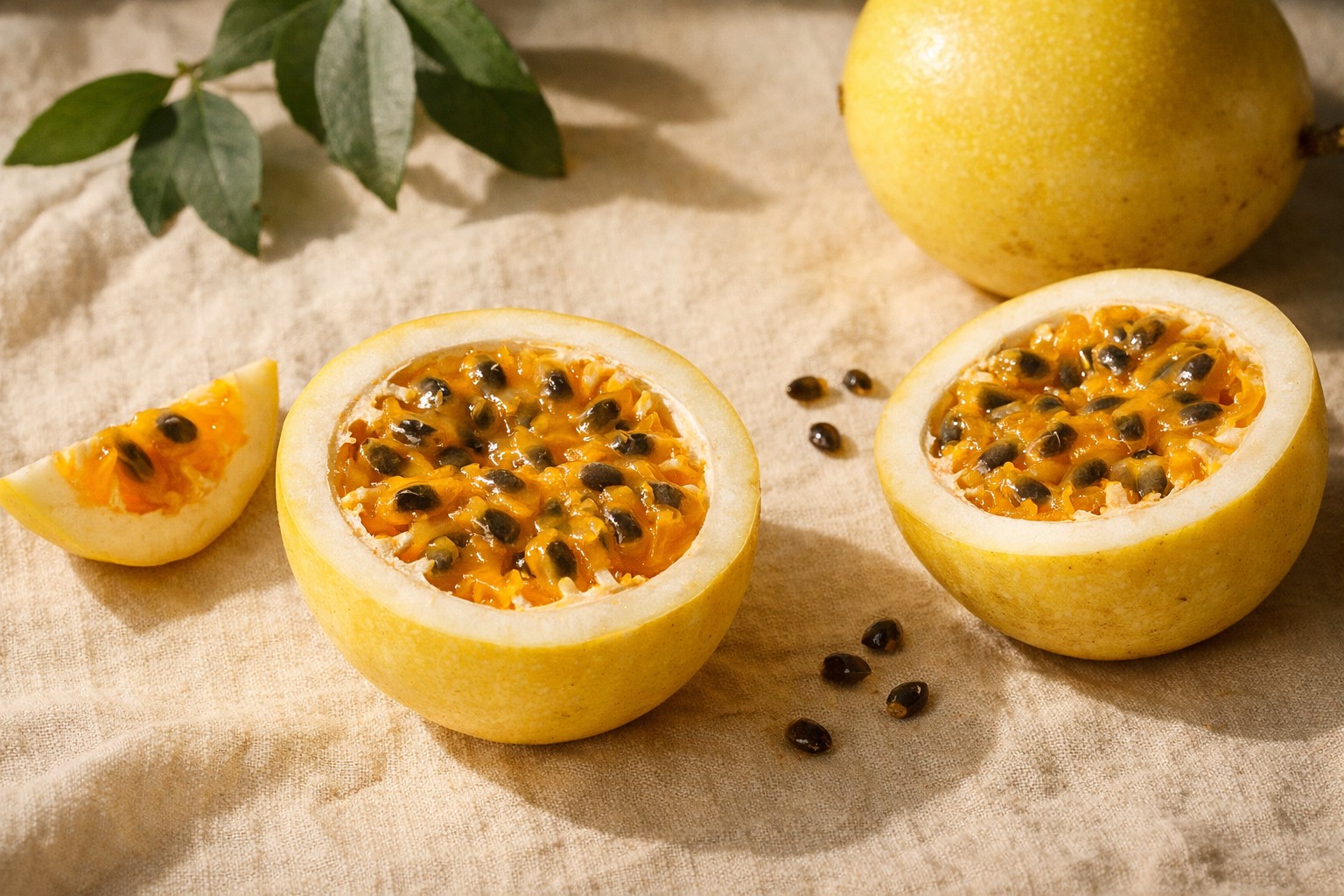
It is a climbing vine fruit with an intensely aromatic pulp, a history rooted in South American Indigenous cultivation, and a research profile that mixes legitimate food science with a fair amount of hype. This site gives maracuyá the treatment it deserves: history, cuisine, chemistry, and caveats.
Maracuyá is the fruit of Passiflora edulis, a climbing vine in the Passifloraceae family that thrives across tropical and subtropical regions worldwide. The name itself comes from Tupi: mara kuya, meaning "fruit that serves itself" or "food in a cuia."[1]
If you have never held one, the fruit is deceptive: a round or oval shell, sometimes wrinkled, that hides a cavity of seed-filled, intensely fragrant pulp. The two main commercial varieties — purple (P. edulis f. edulis) and yellow (P. edulis f. flavicarpa) — have distinct flavor profiles, but both deliver the same signature: tart, sweet, deeply aromatic, and nothing like a mild table fruit.[2]
That intensity is why maracuyá shows up so often as juice, pulp, concentrate, or dessert ingredient rather than something people casually slice. Over 110 phytochemical constituents have been identified from different parts of the plant, with flavonoids and triterpenoids making up the largest share.[2]
The passion flower was named by 16th-century Spanish missionaries who saw religious symbolism in its structure. The fruit's reputation as a relaxant and mood-lifter is supported by real anxiolytic research on Passiflora extracts, though most evidence remains preclinical.[2]
Maracuyá originated in the region stretching from southern Brazil through Paraguay to northern Argentina. Today it is cultivated commercially across South America, the Caribbean, Southeast Asia, Australia, East Africa, and Hawaii.[1]
Maracuyá is often flattened into a generic tropical-juice ingredient online. The actual picture is richer: a fruit cultivated by Indigenous communities in South America long before European contact, with deep roots in Brazilian, Colombian, and Ecuadorian food systems.[1][2]
The cleanest nutritional finding is not "miracle vitamin bomb." It is that maracuyá is a meaningful source of vitamin C, dietary fiber, and polyphenolic compounds, with notable levels of potassium, magnesium, and phosphorus.[1][2]
A 100g serving of raw passion fruit provides roughly 33% of the daily value for vitamin C, making it a meaningful antioxidant source without being extreme.[1]
The fruit ranks higher in polyphenol content than banana, mango, papaya, and pineapple. Piceatannol, a stilbene in the seeds, is the compound generating the most research interest.[4]
Passion fruit is notably rich in dietary fiber, especially pectin. The seeds contribute significant fiber when consumed, which is the traditional way to eat it.[3]
Maracuyá reads as a nutrient-dense tropical fruit — not a miracle supplement. Its combination of vitamin C, fiber, and polyphenols makes it legitimately interesting from a nutrition standpoint, but the numbers are "good fruit" territory, not pharmacological territory.
The strong research signal around maracuyá includes antioxidant, anti-inflammatory, anti-hypertensive, antidiabetic, and anxiolytic activities. But the critical qualifier is that most of this evidence comes from cell studies, animal models, or small-scale human trials — not large clinical programs.[2][3]
Passiflora species have a long history in folk medicine across South America as sedatives and tranquillizers. In Ayurvedic medicine, the plant is used for anxiety and hypertension. These traditions matter historically even before clinical proof.[2]
Hydroethanol extracts of P. edulis leaves have demonstrated anxiolytic activity in animal models at dosages of 50–150 mg/kg.[5] Seed extracts containing piceatannol showed improved insulin sensitivity in overweight adults over an 8-week placebo-controlled trial.[4] Seed extracts also demonstrated antibacterial activity against P. acnes in vitro.[6]
The honest takeaway is that maracuyá is a legitimate subject of food-science and pharmacological interest, but the current evidence base does not justify miracle marketing. The fruit is more compelling as a traditional food with promising bioactive chemistry than as a magic supplement.
Geography, naming, and why South American context beats vague branding.
Read article →The food chemistry is real. The miracle talk usually is not.
Read article →How a tart, seedy vine fruit becomes something lush and drinkable.
Read article →